
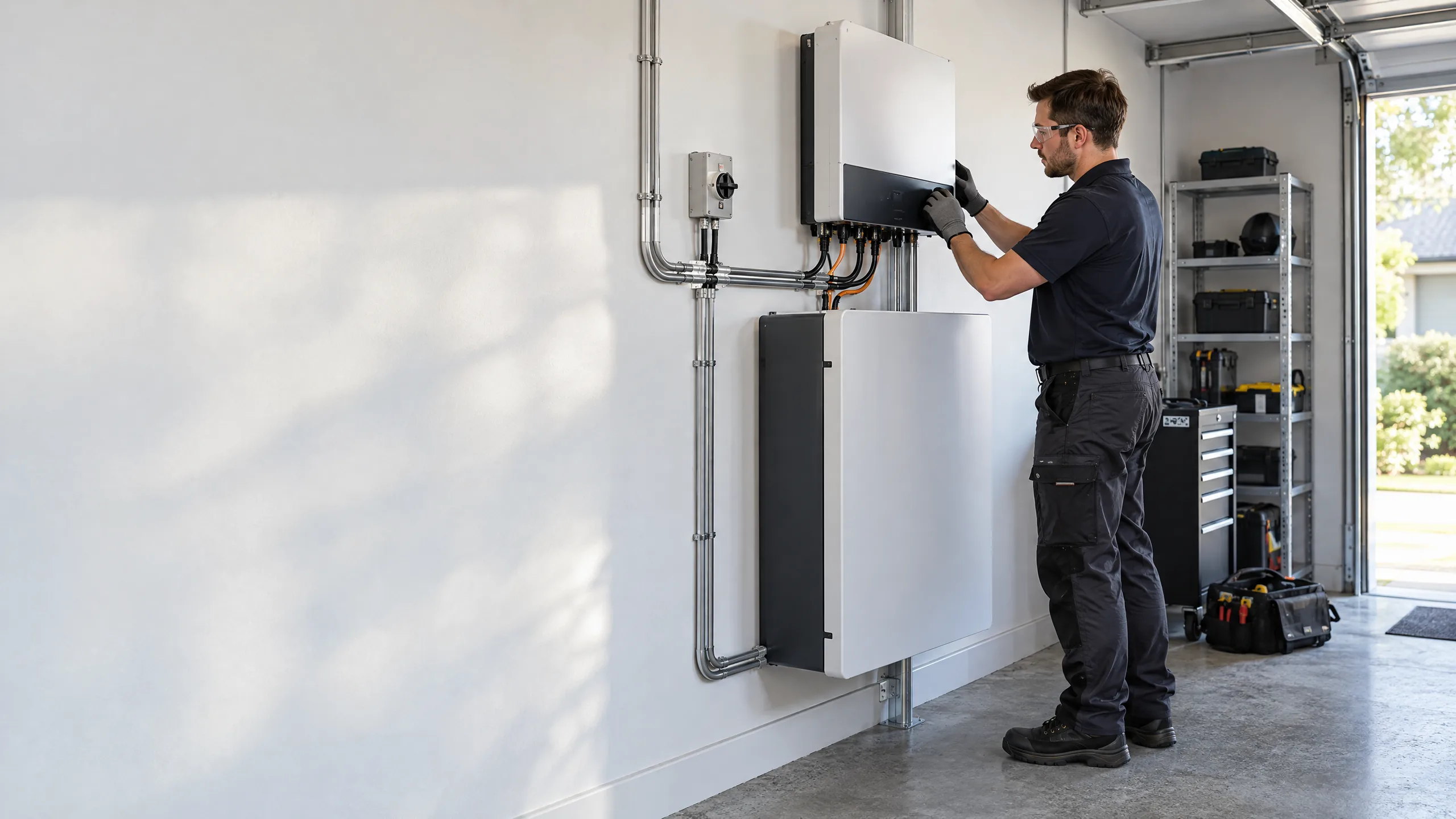
Solar Battery Installation
Solar Battery Installation in Victoria
Store your solar for evening use and reduce what you buy from the grid.
Victorian homes export daytime solar for a few cents while evening power costs full price. A battery sized to your load lets you use your own energy when you need it most. We'll review your usage, design a system that fits your roof and inverter, handle all installation and rebates, and commission it ready to use.
Choose your suburb
Melbourne · West
- Caroline Springs 3023
Melbourne · South East
- Berwick 3806
- Cranbourne 3977
- Clyde 3978
- Narre Warren 3805
- Botanic Ridge 3977
Melbourne · North
- Craigieburn 3064
Melbourne · Inner
- Melbourne 3000
Melbourne · East
- Glen Waverley 3150
- Ferntree Gully 3156
- Croydon 3136
- Wantirna 3152
- Blackburn 3130
- Wheelers Hill 3150
Melbourne · North East
- Epping 3076
- Bundoora 3083
- Mill Park 3082
- Thomastown 3074
- Lalor 3075
- Whittlesea 3757
- Mernda 3754
Geelong area
- Highton 3216
- Torquay 3228
- Armstrong Creek 3217
- Geelong 3220
Ballarat area
- Ballarat 3350
Mornington Peninsula
- Mornington 3931
- Mount Martha 3934
- Mount Eliza 3930
Why install a solar battery in Victoria?
Most Victorian homes on a time-of-use tariff export solar for 10–15 cents per kilowatt-hour during the day but buy it back at 30–50 cents after 4 p.m. A battery lets you shift that cheap solar generation to evening and night, cutting your import hours and peak-time bills. Payback typically falls between 8–12 years once rebates are applied, and batteries usually outlast their warranty.
Victoria's electrical network operator (Ausnet or Powercor, depending on your postcode) requires all batteries on the network to be installed by SAA-accredited electricians and commissioned to their safety standard—this is built into Bill Saver Solar's service. Most suburbs have good roof orientation for solar, and even homes in shadier streets can benefit from a battery, since it stores any surplus generation you produce.
Whether you're chasing energy independence, protection against rising power bills or resilience during blackouts, a battery sized to your evening load and installed with the right inverter and backup configuration is the best investment in home energy most households can make right now.
⏳ Deadlines
- Cheaper Home Batteries steps down in 38 days (1 January 2027)About $252/kWh for the first 14 kWh, $151/kWh to 28 kWh and $38/kWh to 50 kWh (2026 rate) Source: DCCEEW Cheaper Home Batteries, from 1 May 2026 · checked 2026-10-16
- STC discount on new solar shrinks in 38 days (1 January 2027)about 20% less than this year (one fewer deeming year) Source: Clean Energy Regulator (small-scale technology certificates) · set by law
Local solar data
How much power does solar make in Victoria?
Each kW of panels in Victoria makes about 1,366 kWh a year (Melbourne data). That means a 6.6kW system makes around 9,016 kWh a year, or about 25 kWh on an average day. Melbourne averages 4.8 peak sun hours a day.
Figures use PVWatts modelling for a north-facing (south-facing in the northern hemisphere) roof at 20°. Your actual output depends on shade, roof direction and the panels you choose.
| City | Network | kWh per kW a year | Sun hours a day | Grid price per kWh | Yearly saving, 6.6kW |
|---|---|---|---|---|---|
| Melbourne VIC | — | 1,366 | 4.76 | — | — |
Incentives that apply in Victoria
National · battery
Cheaper Home Batteries
About $252/kWh for the first 14 kWh, $151/kWh to 28 kWh and $38/kWh to 50 kWh (2026 rate)
Battery 5–100 kWh, able to join a VPP, connected to rooftop solar
Source: DCCEEW Cheaper Home Batteries, from 1 May 2026 · checked 2026-10-16
National · solar
Small-scale Technology Certificates (STCs)
Upfront discount: kW × zone multiplier × deeming years × STC price
Systems up to 100kW installed by an SAA-accredited installer
Source: SRES: zone multiplier × 5-year deeming × $38 per STC · checked 2026-10-16
VIC · hot water
Solar Victoria hot water rebate
up to $1,400 locally made, $1,000 other
Same $150,000 income cap
Source: Solar Victoria, from 1 July 2026 · checked 2026-10-16
VIC · solar
Solar Victoria panel rebate
up to $1,400
Combined household income $150,000 or less
Source: Solar Victoria, from 1 July 2026 · checked 2026-10-16
Sources: PVWatts v8 (north-facing 20°, 14% losses, nearest station) · SRES: zone multiplier × 5-year deeming × $38 per STC · DCCEEW Cheaper Home Batteries, from 1 May 2026 · Solar Victoria, from 1 July 2026
How big should my solar battery be?
Can a battery power my home in a blackout?
How long does a home battery last?
How much does a solar battery cost in Victoria?
What size battery do I need?
Do I need a new inverter for a battery?
What's the difference between backup and no-backup batteries?
How long does battery installation take?
What maintenance does a battery need?
Can I stack two batteries if I want more storage?
Ready to store your solar?
Book a free usage review and system design. No obligation.