

Skip to content
Solar Battery Installation by Solar Advice

Solar Energy Storage

Solar Battery Installation

Store your daytime solar. Power your home at night.

Daytime solar sells for a few cents; evening power costs full price. A battery sized to your evening load flips that math. We match the right battery and inverter to your home, handle backup configuration if you need it, and manage rebate paperwork so you capture available incentives like the federal Cheaper Home Batteries program. Most installs run $7,000–$15,000 before rebates.

Prefer to talk? Call 0485868633

Step 1 of 2Free · no obligation
Requesting quotes for

Solar Battery Installation

When?

We only use your details to prepare your quote. Privacy

⏳ Deadlines

Lock in a quote

Why most homes export cheap solar during the day and buy back power at full price at night.

Your solar system generates most power between 9am and 3pm. If you're at work or running low-energy appliances, that surplus flows back to the distribution network for a few cents per kilowatt-hour. Then, when the sun sets and you cook dinner, run the dishwasher and watch TV, you buy that power back at the full retail rate—often 3–5 times higher. A battery intercepts your midday export, stores it, and feeds your home during peak evening hours instead. The maths flip: you keep the power you generated instead of selling it cheap and buying it back dear.

Without a battery, you're buying two-thirds of your electricity at full price. With one sized to your evening load, you use it for eight to ten hours and offset peak-rate consumption. The payback timeline depends on your export rate, evening consumption and available rebates—typically three to seven years—after which the battery is almost free energy.

What this covers

  1. 01

    10kWh Battery Installation

    Entry-level system for homes with 10–15kWh evening load. Covers most of your after-sunset consumption. $7,000–$9,500 before rebates.

  2. 02

    13.5kWh Battery Installation

    Popular mid-size system for average Australian homes. Stores most or all of your solar export and powers you through the evening. $8,500–$11,500 before rebates.

  3. 03

    Stacked Battery Systems (15–20kWh+)

    Two or more batteries for homes with large evening loads or high solar generation. Maximises self-consumption and reduces grid dependence. $12,000–$18,000+ before rebates.

  4. 04

    Backup Battery with Gateway

    Battery system with backup gateway and isolated circuits for blackout protection. Powers essential or whole-home circuits when the grid fails. Adds $1,500–$3,000 to standard system cost.

  5. 05

    Battery-Only Retrofit

    Adding a battery to an existing solar system without replacing your inverter. Fast, lower cost than DC-coupled systems. Ideal for homes with working solar and good afternoon export.

How we size your battery and design your system.

Sizing a battery starts with understanding your electricity pattern. We ask for your last 12 months of bills or download your monitoring data if your solar has a logger. We look for two numbers: your average evening load (the kilowatts you use between 4pm and 9pm) and your average daily export (the kilowatt-hours flowing back to the grid on clear days). If you export 15kWh and use 12kWh between 4pm–9pm, a 12–13.5kWh battery covers most of your evening. If you export 20kWh and use 18kWh in the evening, a 15–20kWh system or stacked batteries make sense.

Next, we check inverter and battery compatibility. Your existing solar inverter might already support battery input (many modern models do); if not, we add a separate battery inverter or replace the whole unit. AC-coupled systems (battery on the AC side) work with any solar inverter. DC-coupled systems (battery directly on the DC bus) are more efficient but need an inverter that supports them. We confirm that your chosen battery brand (LG Chem, Tesla Powerwall, Solarwatt, Generac PWRcell etc.) pairs safely with your inverter, then design the mounting location—indoor garage, outdoor weatherproof enclosure, or wall-mounted—based on your home's layout and climate. A signed design drawing goes to your distribution network operator and the Clean Energy Regulator (CER) if you're claiming rebates or STCs.

Solar Battery Installation — How we size your battery and design your system.

Installation, commissioning and getting your rebates.

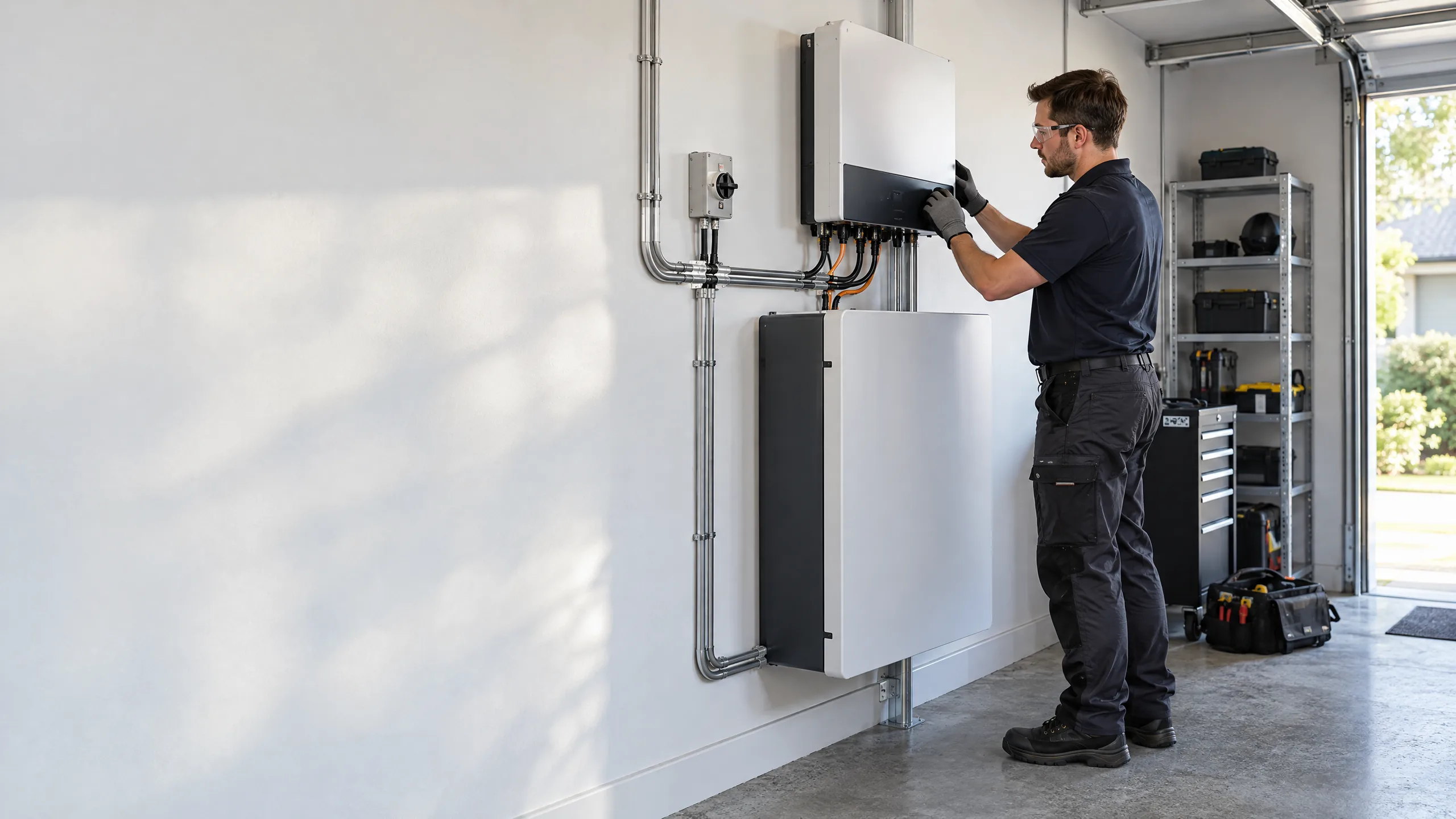
On installation day, our SAA accredited electrician turns off your solar system and main switchboard, runs new cabling from the battery to the inverter and switchboard (following Australian Standard AS/NZS 3000 and local network rules), mounts the battery securely, and makes all connections watertight. If you've chosen backup, we install a special gateway (such as Enphase IQ or SMA Home Manager) that disconnects your home from the grid in a blackout and isolates the battery to essential circuits. Every connection is tested for voltage, current, earthing and arc-fault protection before the system powers on. We then commission the battery: set the charge and discharge rates in the app, enable any self-consumption or time-of-use modes you need, and walk you through how to read the display or app.

Rebate paperwork happens during or right after install. If you're using the federal Cheaper Home Batteries program, we lodge your system details with the CER and your installer network (such as a NETCC Approved Seller partner). You'll need proof of installation and an invoice showing usable capacity; the rebate is processed as a discount at point of sale or a cashback within weeks. State rebates vary—NSW, Victoria, South Australia and Queensland each have different schemes—so we check current amounts with your state energy agency and fill in the forms on your behalf. If you have solar panels and are claiming Small-scale Technology Certificates (STCs), the CER calculates your upfront discount based on your system size, climate zone and deeming years ($38 per STC, multiplied by zone factor and 5-year deeming period). This discount also applies at point of sale. You'll walk away with a fully working battery system, full documentation, and rebates already factored into your final cost.

Solar Battery Installation — Installation, commissioning and getting your rebates.

Pricing guide

How much does a solar battery installation cost in Australia?

A typical 10–13.5kWh battery system costs $7,000–$15,000 before rebates. Price is driven by usable capacity (kWh), whether you add backup, your inverter choice, battery brand and warranty, and indoor versus outdoor mounting. Federal rebates from the Cheaper Home Batteries program can knock $1,500–$3,500 off depending on capacity; state rebates add another $500–$2,000 in eligible areas. Ask us to confirm current rebate amounts with the Clean Energy Regulator and your state energy agency—they change on set dates.

  • Usable capacity: 5kWh costs less than 20kWh; most homes choose 10–15kWh.
  • AC-coupled vs DC-coupled: AC is simpler retrofit; DC is more efficient and costs slightly less.
  • Backup configuration: Adding a gateway and isolated circuits adds $1,500–$3,000.
  • Brand and warranty: LG Chem, Tesla, Solarwatt and Generac differ in price, efficiency and 10–15 year warranty terms.
  • Inverter: New hybrid inverter runs $2,500–$4,500; retrofitting into existing inverter saves cost.
  • Mounting location: Indoor garage is simplest; outdoor enclosure costs more; wall-mount in exposed areas may need extra protection.
Job typeLowTypicalHigh
10kWh battery retrofit (AC-coupled)$7,000$8,500$9,500
13.5kWh battery with new hybrid inverter$8,500$11,000$13,000
15–20kWh stacked battery system$12,000$15,500$18,000
Battery with backup gateway and circuits$9,500$13,000$16,000

Prices shown are market guidance for Dandenong, Point Cook · Craigieburn · Tarneit · Pakenham · Reservoir · Berwick · Werribee · Glen Waverley · Sunbury · St Albans and do not include GST unless stated. Final cost depends on site inspection, distribution network fees, and available rebates. Ask for a written quote after we've reviewed your usage and system design.

Typically included

  • Usage review from 12 months of electricity bills or solar monitoring data
  • Battery and inverter compatibility assessment
  • Battery, mounting frame and all cabling
  • Electrical work by SAA accredited electrician (AS/NZS 3000 compliant)
  • Commissioning, app setup and performance testing
  • Rebate and STC paperwork lodgement with CER or state agency

Often excluded

  • Solar panel installation (battery-only service; we do solar separately)
  • Upgrade to main switchboard (if required by your network, extra cost applies)
  • Removal or disposal of old battery or inverter
  • Structural modifications to roof or wall (ask if your mounting location needs reinforcement)

Installation must be carried out by an SAA accredited electrician. All work is notified to your distribution network operator and must comply with Australian Standard AS/NZS 3000 and your network's connection rules. Proceeding with an unlicensed installer or attempting DIY will void warranties, breach electrical safety law, and disqualify you from rebates. We verify accreditation and network requirements before we start.

Questions to ask every installer

Checklist for choosing solar battery installation
  1. 1Is the installer SAA accredited and can they lodge CER paperwork?
  2. 2Which battery brands do you stock and what are their warranty terms?
  3. 3Do you support backup configuration and what does it cost?
  4. 4How do you calculate the right battery size for my home?
  5. 5Will you handle all rebate applications—federal, state and STCs?

Local solar data

How much power does solar make in Victoria?

Each kW of panels in Victoria makes about 1,366 kWh a year (Melbourne data). That means a 6.6kW system makes around 9,016 kWh a year, or about 25 kWh on an average day. Melbourne averages 4.8 peak sun hours a day.

Figures use PVWatts modelling for a north-facing (south-facing in the northern hemisphere) roof at 20°. Your actual output depends on shade, roof direction and the panels you choose.

CityNetworkkWh per kW a yearSun hours a dayGrid price per kWhYearly saving, 6.6kW
Melbourne VIC — 1,366 4.76 — —

Incentives that apply in Victoria

National · battery

Cheaper Home Batteries

About $252/kWh for the first 14 kWh, $151/kWh to 28 kWh and $38/kWh to 50 kWh (2026 rate)

Battery 5–100 kWh, able to join a VPP, connected to rooftop solar

Source: DCCEEW Cheaper Home Batteries, from 1 May 2026 · checked 2026-10-16

National · solar

Small-scale Technology Certificates (STCs)

Upfront discount: kW × zone multiplier × deeming years × STC price

Systems up to 100kW installed by an SAA-accredited installer

Source: SRES: zone multiplier × 5-year deeming × $38 per STC · checked 2026-10-16

VIC · hot water

Solar Victoria hot water rebate

up to $1,400 locally made, $1,000 other

Same $150,000 income cap

Source: Solar Victoria, from 1 July 2026 · checked 2026-10-16

VIC · solar

Solar Victoria panel rebate

up to $1,400

Combined household income $150,000 or less

Source: Solar Victoria, from 1 July 2026 · checked 2026-10-16

Sources: PVWatts v8 (north-facing 20°, 14% losses, nearest station) · SRES: zone multiplier × 5-year deeming × $38 per STC · DCCEEW Cheaper Home Batteries, from 1 May 2026 · Solar Victoria, from 1 July 2026

Brands we install

Brands we install

Ask us about current stock and warranty terms for each brand.

Panels
Jinko →Trina →LONGi →AikoRECCanadian Solar →SunPower (Maxeon)
Inverters
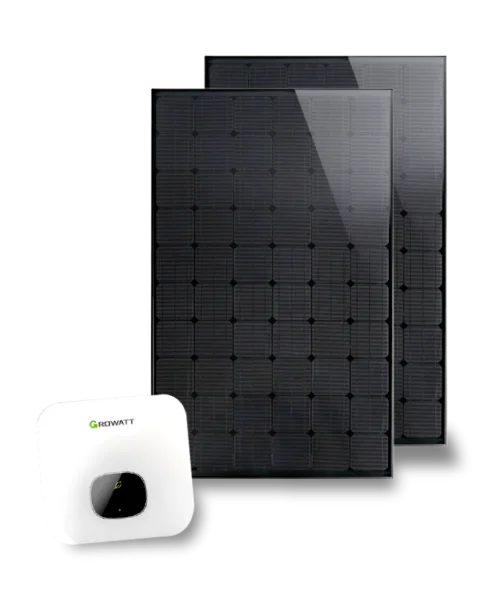
Fronius →Sungrow →SolarEdgeEnphaseGoodWe →HuaweiGrowatt →
Batteries
Tesla PowerwallSigenergy →BYDAlpha ESS →Enphase IQ BatterySungrow SBR →FranklinWH

Will my existing inverter work with a battery, or do I need to replace it?

Your existing inverter determines whether you can add a battery without replacement. DC-coupled systems require your inverter to have a built-in DC input for the battery charger—most older inverters don't have this, so replacement is necessary. AC-coupled systems work with almost any inverter because the battery and its inverter operate independently on your home's AC circuits, making retrofit simpler and often cheaper. Solar Advice assesses your current inverter during the design phase and advises whether replacement is cost-effective or if AC-coupling suits your setup.

Replacement inverters typically cost $2,000–$4,000 installed and are usually paired with DC-coupled batteries for new installations because they're more efficient. However, if your existing inverter is relatively new and reliable, AC-coupling may avoid that expense and still deliver strong savings. The choice depends on your inverter age, your evening load profile, and whether maximising efficiency justifies the replacement cost against your payback timeline.

  • ✓DC-coupled batteries require inverter replacement unless your current model has a battery DC input—check your inverter manual or ask us
  • ✓AC-coupled systems retrofit to almost any existing inverter without replacement
  • ✓Inverter replacement adds $2,000–$4,000 to your installation cost
  • ✓New installations typically pair DC-coupled batteries with new inverters for higher efficiency
  • ✓We design your system around your existing equipment where possible to minimise cost and disruption
Is solar battery installation worth it for my home?

A battery is worth installing if you export at least 10kWh on a clear day and use 8kWh or more between 4pm and 9pm. The maths work because you capture cheap daytime power (often given away) instead of buying it back at full price in the evening. If you're rarely home during the day or use most of your solar in real time, a battery may not pay back within seven years.

Payback typically ranges from three to seven years before rebates and incentives, depending on your local electricity rate, evening consumption and the size of your system. The federal Cheaper Home Batteries Program (from 1 July 2025), state rebates and Small-scale Technology Certificates under the SRES can cut your out-of-pocket cost by 30–50%. Ask your installer to model your savings using your last 12 months of energy bills and current local rates from your retailer.

A battery also adds grid resilience and blackout protection if you install a backup gateway. Even if the financial case is borderline, having stored energy during a network outage has real value for families, remote workers or businesses.

  • ✓Battery is worth it if you export 10+ kWh/day and use 8+ kWh at evening peak
  • ✓Payback is 3–7 years before incentives; often faster with rebates
  • ✓Check federal Cheaper Home Batteries Program and state-specific schemes with your installer
  • ✓Backup protection has non-financial value during outages

What rebates and incentives can I claim for a battery installation?

The federal Cheaper Home Batteries Program (from 1 July 2025) offers grants to households installing a new battery or upgrading an existing one. Small-scale Technology Certificates (STCs) under the federal SRES scheme also apply to battery installations; the number of certificates depends on your system size and postcode. Your installer can handle STC paperwork and rebate applications on your behalf.

Many states also run their own rebate schemes—for example, Victoria's Powering Victoria Home scheme. Eligibility and payment amounts change on set dates set by the Clean Energy Regulator and your state energy agency. Always ask your installer to confirm current program rules, your eligibility and exact rebate amounts before you sign a contract.

NETCC Approved Sellers are authorised to sell STCs, and your installer should hold SAA accreditation. Ask them to provide a quote that shows the rebate value separately from the system cost so you understand your real out-of-pocket expense.

  • ✓Federal Cheaper Home Batteries Program: grants available (check CER for current amounts)
  • ✓Small-scale Technology Certificates (STCs) under SRES: rebate value depends on system size and location
  • ✓State rebates (e.g., Victoria, NSW, Queensland): vary by state and change on set dates
  • ✓Installer should confirm your eligibility and provide itemised rebate value in the quote
  • ✓Always check the Clean Energy Regulator website for current program rules before committing

Questions

Common questions

Still have questions? Ask us or call 0485868633.

How much does a solar battery cost in Australia?
A typical 10–13.5kWh battery system costs $7,000–$12,000 before incentives. Price depends on usable capacity, backup capability, indoor or outdoor location, and brand warranty terms. The federal Cheaper Home Batteries program offers tiered discounts: $252/kWh for the first 14kWh, $151/kWh from 14–28kWh, and $38/kWh from 28–50kWh (2026 rate, from 1 May 2026). Confirm current rebate amounts with the Clean Energy Regulator (CER) or your state energy agency, as these change on set dates.
What size battery do I need?
Battery size matches your evening load and export pattern. We review your electricity bills or solar monitoring data to see how much you use after sunset and how much you're exporting during the day. A typical home using 10kWh in the evening might fit a 10–13.5kWh battery; homes with larger evening loads or high export may need 15–20kWh or stacked units. An oversized battery costs more and sits idle; an undersized one won't cover peak evening demand. We'll calculate the right fit during your usage review.
Can a battery power my home during a blackout?
Yes, if you choose a backup configuration with an appropriate inverter and backup gateway. A standard battery system disconnects during a blackout to protect the distribution network. A backup system includes a special gateway that isolates your home and lets the battery power essential circuits (or the whole home, depending on capacity). Backup adds $1,500–$3,000 to the install cost and requires compatible inverter and battery hardware. We'll size the backup circuit to your needs—fridge, lights, medical equipment or your whole house.
Do I get rebates or STCs for a battery?
Yes. The federal Cheaper Home Batteries program offers rebates based on usable capacity (tiered discounts apply from 1 May 2026). Small-scale Technology Certificates (STCs) are available if your system includes solar panels; battery-only retrofits do not generate STCs. Your state may also offer rebates—confirm current amounts with your state energy agency. We handle rebate and STC paperwork as part of installation; you'll need a CER-registered installer to claim the benefits. Ask us to verify which incentives apply to your postcode and system size.
How long does a solar battery installation take?
Typical install takes one to two days on-site, depending on battery type (AC-coupled or DC-coupled), whether you're adding backup, and your home's wiring layout. AC-coupled batteries (added to existing solar) are faster; DC-coupled systems (integrated with new solar) take longer because we coordinate inverter placement, cabling and monitoring setup. After install, commissioning and app setup takes a few hours. We'll confirm the timeline when we visit.
What warranty does a solar battery have?
Warranty terms vary by brand and type. Most lithium batteries carry 10–15 year manufacturer warranties covering defects and degradation (typically guaranteeing 70–80% capacity after 10 years). Inverter warranties are usually 5–10 years. We supply battery and inverter documentation and register your system with the manufacturer. Extended warranty options are available from some brands. Ask us about warranty terms for the specific battery model we recommend for your home.
Do I need an electrician to install a solar battery?
Yes. Battery installation must be done by an SAA accredited electrician in Australia. SAA accreditation means the installer has passed safety and technical competency checks set by Solar Accreditation Australia. Our electricians are SAA accredited; we handle all electrical work, commissioning, and lodging paperwork with your distribution network operator. Never attempt battery installation yourself or use an unlicensed tradesperson—you'll void warranties and breach electrical safety rules.
Which battery should I choose: AC-coupled or DC-coupled?
AC-coupled batteries plug into your existing solar system's AC side and work with any inverter—good for retrofits. DC-coupled systems integrate directly with your inverter and are more efficient because they skip one AC/DC conversion; they suit new installs or when you're replacing your inverter anyway. AC-coupled systems are simpler to add later; DC-coupled systems cost slightly less and run 3–5% more efficiently. We'll recommend the right approach based on your existing setup and goals.
solar — final

Ready to store your solar?

Get my free quotes →

Get a free usage review and battery sizing quote.

Home batteries

Home Battery Cost Guides

Costs, rebates & finance

Solar & Battery RebatesSolar Finance & Repayment CalculatorBattery Size & Savings Calculator

Guides

Is a Solar Battery Worth It in Australia? (2026)How Much Does Solar Cost in Australia? (2026 Guide)Solar Rebates and Incentives in Australia (2026 Update)What Size Solar System Do I Need?

Related

Call Get a free quote →
Tap to call